Written by
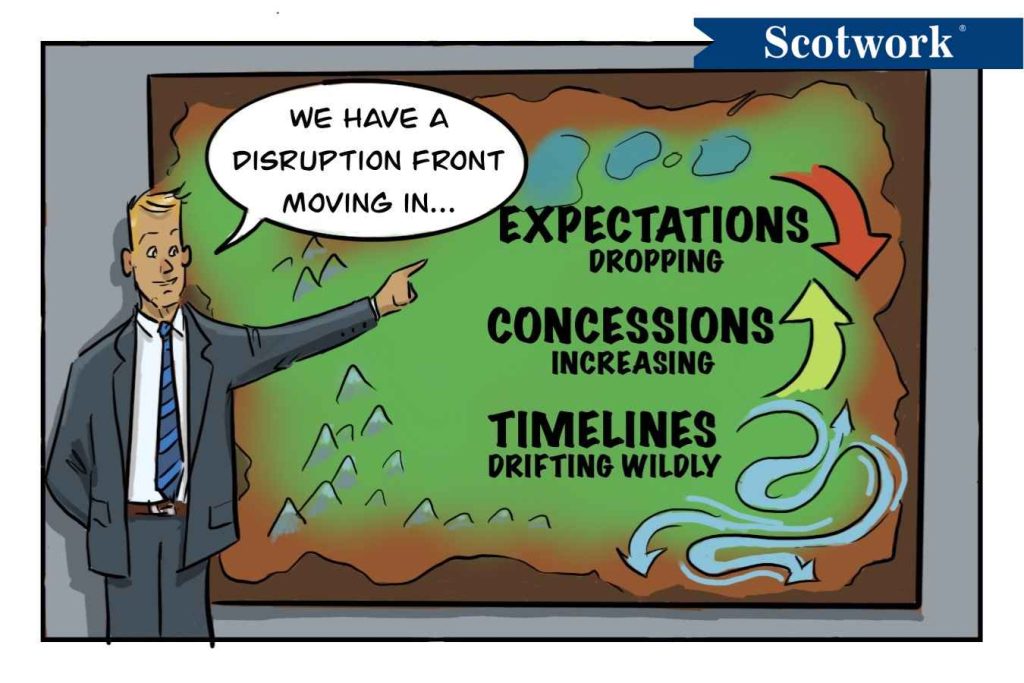
We all felt really good about the busy week ahead, and then a major winter storm arrived. It swept across a huge portion of the US, bringing with it a cocktail of snow, ice, bitter cold, power outages, and travel delays. In other words, chaos — an underrated teacher not just in life, but also in negotiation.
Negotiation isn’t always about what you do when everything goes right. It’s often about what you do when everything goes sideways: You’re stuck at Gate C14, and your “simple plan” becomes a 13-step crisis-management flowchart that ends with “sleeping in an airport Chili’s.”
Let’s talk about what to do when your plans get disrupted, whether by a winter storm, a supplier issue, a budget cut, or the client suddenly saying, “We need this by Friday.” (Why do they always need it by Friday?)
Step 1: Stop Negotiating with Reality
Reality is not a stakeholder and doesn’t care about your Gantt Chart.
If the storm shuts down flights, closes offices, or knocks out power, “But that’s not convenient for us” is not a counteroffer. The faster you accept the new conditions, the faster you can negotiate within them.
Pro tip: Your attitude is the difference between “solution” and “meltdown.” Your goal is to move quickly from, “This shouldn’t be happening” to “This is happening. What now?”
Step 2: Identify What Actually Matters
In the midst of chaos, people tend to negotiate for the wrong things.
For instance, you might see frantic emails like, “We HAVE to keep the original schedule.” Is that what matters most? Probably not. What matters most is the outcome.
When you know what matters most, you stop protecting a fragile plan/strategy and start protecting the result.
Ask your stakeholders . . .
- What’s the real objective here?
- What’s the “must-have”?
- What can move without breaking the deal?
Step 3: Don’t Panic — Trade
Chaos also creates a dangerous temptation: You start making concessions like you’re throwing sandbags at a flood. This might sound like, “No problem, we’ll just figure it out.” That’s how you end up “figuring it out” at 2 am with your laptop on 4% battery.
Instead, negotiate your flexibility. When you start to trade, you stop throwing sandbags and start ensuring value.
Try these examples . . .
- “If we reduce scope, then we can move delivery up.”
- “If we change the success criteria, then we can keep the deadline.”
- “If we do it virtually, then we can meet this week.”
Step 4: Use the Storm as Cover (Yes, Really)
Here’s the silver lining no one talks about: Chaos gives you permission to revisit things you were afraid to bring up. A winter storm is the ultimate neutral third party. It’s a giant, swirling excuse to say, “Given the new conditions, we should revisit the plan.”
This is especially useful if the original agreement was, let’s say, aspirational. Since the status quo has changed, it’s an opportunity to revisit what wasn’t working for you and seek a better outcome.
Step 5: Make Your Next Move Obvious
You can create a strategic advantage amid chaos if you make the next step painfully easy. Simply present people with clear choices like. . .
- “We reschedule to next week, or we hold the meeting virtually and reduce it to 45 minutes. Which option do you like?”
- “Either we can ship a partial now, remainder next week or ship everything later and apply a credit. Which do you prefer?”
A major storm can disrupt travel, schedules, and supply chains across the country, but it doesn’t have to disrupt your ability to negotiate with skill and find creative solutions that everyone can support.
And that’s not just weather advice. That’s negotiation.
Negotiation Training and Consulting to Help You Weather Disruptions and Chaos.
Chaos can disrupt schedules, supply chains, and more, but it doesn’t have to disrupt your ability to negotiate with skill and find creative solutions that everyone can support. Rely on Scotwork’s expertise to help you negotiate your best outcomes.