Written by
I’m an Olympics junkie. With the Winter Games happening in Milan, I’m glued to my screen, watching sports I barely understand. Skeleton? Terrifying. Curling? Oddly mesmerizing. Skimo? Baffling.
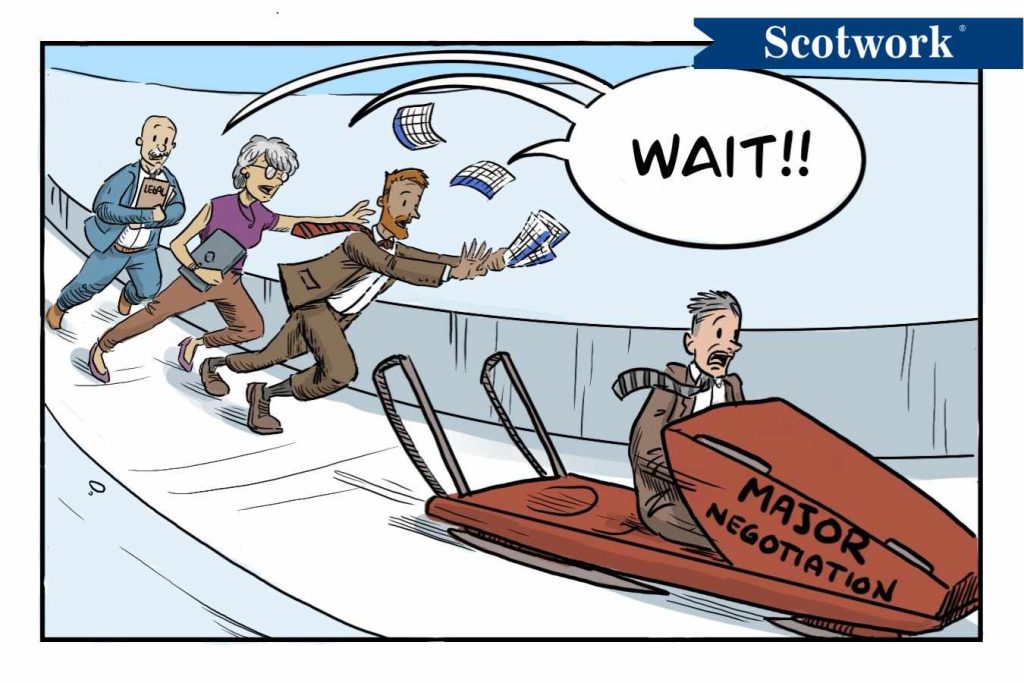
But this week, I watched something that made me cringe. The US four-man bobsled team had a catastrophic start. Three members failed to load into the sled. They just . . . didn’t get in. Which left one guy, the pilot, sailing down an icy track at 90 mph doing a job that requires four people.
It was painful to watch. They intended to work as a team, but it just didn’t happen. I see this a lot during negotiations.
When Your Team Doesn’t Show Up
A company is heading into a major negotiation. They assemble their team of experienced professionals: Procurement, Legal, Operations, Finance. Then the negotiation starts, and suddenly that team isn’t there.
Legal assumed everyone understood the liability language and sent their comments via email. Operations was supposed to explain the technical requirements, but they figured Procurement could handle it. Finance was going to model different scenarios, but they never got around to it.
So, Procurement (your bobsled pilot) ends up steering the whole thing alone, answering questions they’re not equipped to answer, making commitments they don’t have authority to make, and trying to do four people’s jobs while hurtling down the negotiation track.
Then, at the end, when it’s time to close the deal, they have to scramble to get buy-in from all the people who should’ve been there. Except now, those people are reviewing terms they didn’t help shape and finding problems that could’ve been solved weeks ago.
You can’t win gold medals like that. Here are 5 ways to ensure your team is in your negotiation sled . . .
- Pick a committed team. Ensure your team participates in the appropriate sessions, does the prep work, and is present when decisions get made. If they can’t commit the time, find someone who can. A team of three engaged people beats a team of five where two never show up.
- Practice the load-in before race day. That US bobsled disaster didn’t happen because the athletes were unqualified. It happened because something broke down in execution at the critical moment. Your team needs to practice together before the negotiation begins. Run scenarios. Test your positions. Make sure everyone knows their role and can execute when it counts.
- Know who’s steering and who’s braking. In bobsled, the pilot steers and the brakeman stops. In negotiations, someone needs to lead the discussion and someone needs to know when to pause or walk away. Assign these roles clearly. The worst negotiations involve teams where everyone thinks someone else is in charge or, worse, everyone thinks they’re in charge.
- If someone falls off mid-run, call a timeout. If you start a negotiation session and realize a key team member isn’t there (literally or figuratively), stop. Reschedule. It’s better to delay than to have one person trying to do everyone’s job poorly. The other side will respect the professionalism more than they’ll respect watching you struggle.
- Don’t make one person do everything. When you’re leading, you don’t have to do everything. Have one person ask questions, someone else take notes, and another person be a subject matter expert as necessary. When you overload one person, expensive mistakes can happen.
The Milan Olympics remind us that team events require actual teams. Not talented individuals working separately. Not one person doing everyone’s job. Teams.
Before your next negotiation, ask yourself, “Is my whole team actually getting in the sled? Or am I asking one person to steer, push, and brake their way down the mountain alone?”
Negotiation Training and Consulting to Help You Build a High-Performance Team.
Rely on Scotwork’s expertise to make your team gold medalists in their negotiations.