
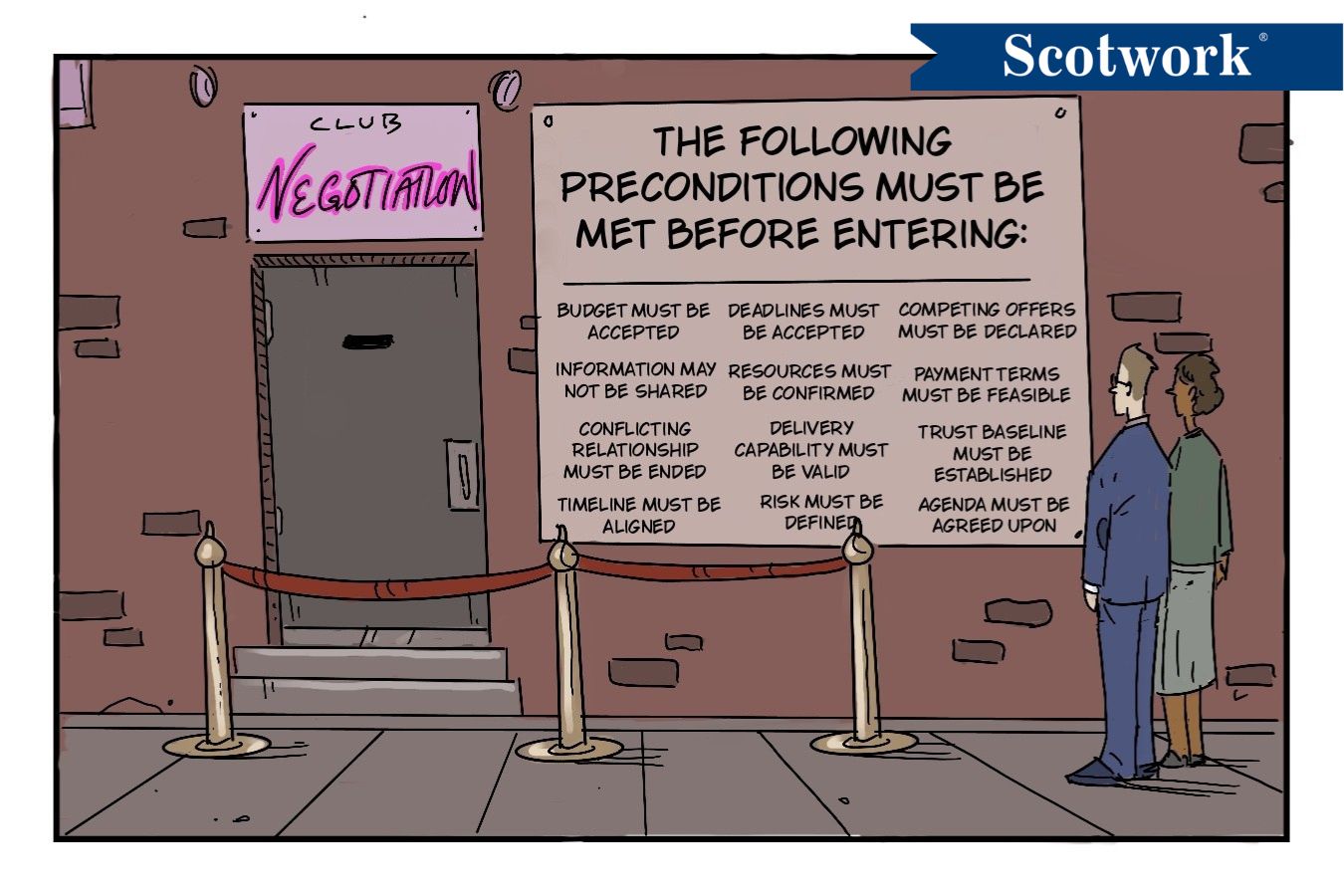
There’s a moment in almost every significant negotiation when someone plants a flag: “Before we go any further, you need to do this.” A precondition to continue a negotiation.
It’s happening right now between the United States and Iran. At the time of this writing, Iran refuses to send negotiators to Pakistan unless the US lifts its naval blockade and releases a seized cargo ship. The US, meanwhile, has its own demands — open the Strait of Hormuz, halt uranium enrichment — before it will consider easing pressure. Both sides are essentially saying, “You go first.”
This standoff can be frustrating to deal with, but it’s not impossible to overcome. Here are 5 approaches that can help you get past preconditions.
The Game of Chicken
The most instinctive response to a precondition is to hold your ground. This strategy has merit — if your read on the power dynamic is correct. The side with the stronger position, the better alternative outcomes, and less urgency can usually afford to hold. But negotiators consistently underestimate how quickly power shifts.
The side that “wins” the standoff today plants a seed of resentment that grows into the next conflict. When circumstances change and power shifts, the side that was forced to capitulate overcorrects, taking back what they gave up, and then some, as a signal that they won’t be put in that position again.
The Open Door
A more elegant approach — one that experienced negotiators reach for when the game of chicken feels too risky — is what we call The Open Door.
Instead of accepting or rejecting the precondition outright, you suspend it temporarily with a conditional question: “Just suppose I could agree to your precondition. What would the rest of the deal look like?” This creates space to discover whether there’s even a deal worth having before both sides expend all their energy fighting over the entry conditions.
The Open Door works because most preconditions are signals of something else — of resolve, of domestic political constraints, or of testing how serious the other party is. When you respond with a hypothetical rather than a yes or no, you honor the signal without committing to action. Both sides can say they haven’t moved, yet the conversation continues.
The risk: A skilled negotiator on the other side may try to collapse the hypothetical back into a real commitment. But successfully holding the conditional framework under pressure can unlock movement that a direct confrontation never would.
Break the Precondition Apart
“End the blockade” or “halt enrichment” sound absolute but typically contain multiple components, some of which may be tradeable. When you disaggregate a precondition, you open the conversation from “agree or disagree” to “which parts can we build on?”, which is a much more productive place to be.
This is harder than it sounds. It requires the other side to explain their precondition rather than just assert it, which they may resist. But the negotiator who can move a conversation from positions to components is typically the one who finds a path forward.
Use a Third Party to Absorb the Tension
Sometimes the most powerful thing you can do with a precondition is hand it to someone else. A skilled intermediary can act as a buffer, holding the precondition in a separate channel, working equivalencies behind the scenes and allowing both parties to tell their audiences that they haven’t moved, while the intermediary quietly finds a path. This is the role that Pakistan is attempting to play in the current Iran-US situation.
This tactic helps mitigate emotion and keep momentum going forward. However, each negotiator needs to trust that the intermediary is representing their positions faithfully.
The Simultaneous Gesture
Rather than one party making a unilateral concession on a precondition, both sides agree to make coordinated, reciprocal gestures that are choreographed carefully so both can claim they received something and neither had to go first.
This works well if both parties can trust each other enough to step together. You probably experienced this as a kid, fighting over something with a sibling or friend. Both of you grabbed a toy at the same time and after yelling, “You let go first!” someone finally said, “We’ll let go at the same time . . . one . . . two . . . three!” It’s the same concept — and as we all learned, not everyone lets go on three.
The Thread That Runs Through All of It
What these approaches share is a refusal to treat the precondition as the real negotiation.
Preconditions are almost never purely substantive. They’re strategic. They’re about testing the other side’s seriousness, managing domestic audiences, and signaling that you won’t be pushed around. A negotiator who understands that can respond to the signal without necessarily transacting on the substance and keep the conversation moving.
The Iran-US situation is a reminder that this applies whether you’re negotiating in a boardroom or across an ocean. The form changes, the dynamics don’t.
Negotiation Training and Consulting to Help You Get Past Preconditions.
Rely on Scotwork’s expertise to help you overcome standoffs, so you can keep the conversation moving to the real negotiation.