Written by
I like to cook, and I can make a few of my family’s favorite dishes really well. I even watch cooking shows sometimes and think, I could do that!
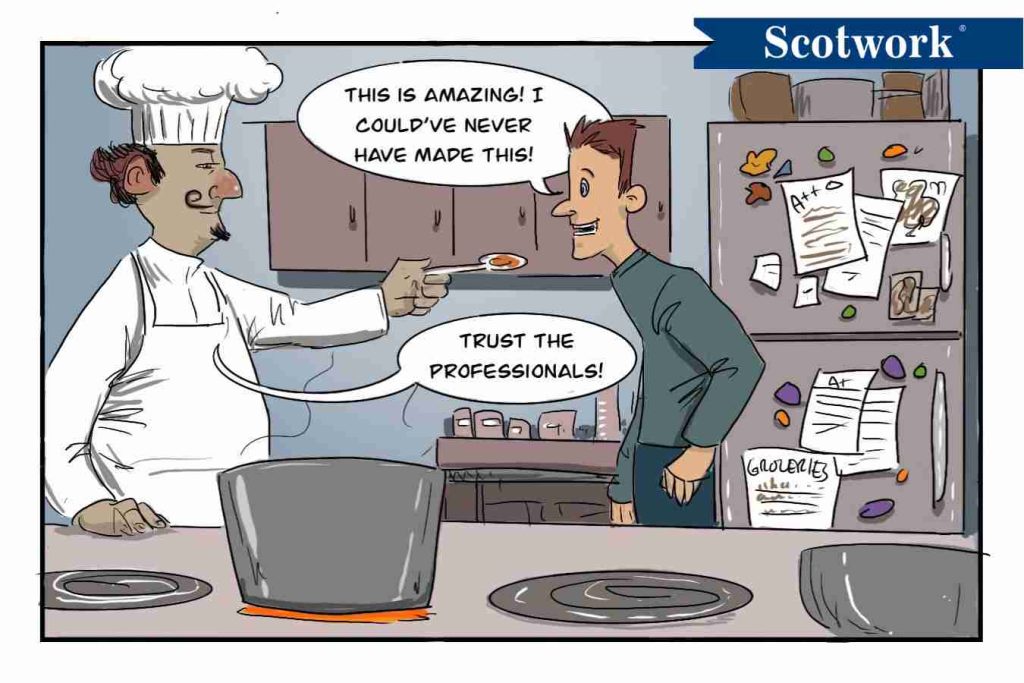
I was feeling pretty good about my skills . . . until I cooked alongside professional chefs. Talk about a humbling experience.
At our team kickoff meeting, we took a cooking class led by two pros, Chef Jonathan and Chef Courtney. We split into stations, each team responsible for a different part of the meal.
Every station had a recipe and ingredients laid out. Or, as the French say, mise en place. All we had to do was follow the recipe.
It seemed easy . . . until the chefs started checking in on us. We learned there was a lot more to cooking than simply “doing the steps.” There was technique, timing, precision, and subtleties you’d never think about if you’d only cooked casually.
One group was making crab cakes, only their crab cakes didn’t look anything like the example. Chef Jonathan stepped in and demonstrated how to form the patties properly. In about 10 seconds, he’d shaped a restaurant-ready crab cake.
Another group was making chicken piccata. Step one: pound the chicken breast into a thin fillet. Again, seemed straightforward . . . until the chicken started splitting under the mallet.
Chef Courtney jumped in, demonstrating a technique that was more “pound and push,” working from the center out, flattening the meat evenly without destroying it. Same ingredients. Same goal. Totally different result.
Meanwhile, another group was chopping herbs. Chef Jonathan showed the team how to roll the leaves, guide the knife, and cut cleanly without turning them into bruised, lifeless flakes. The difference was dramatic.
Everything we were shown, from the big techniques to the tiny nuances, highlighted a simple truth: The professionals weren’t better because they had a secret recipe. They were better because they had refined their craft through coaching and repetition.
While we enjoyed the excellent meal we’d prepared under their watchful eyes, one of my colleagues made a comment that stuck with me: “This is exactly what it’s like when people negotiate with professional negotiators.”
Like any professional skill, experience changes everything. Frequency of use improves instinct. Practice sharpens execution. Coaching and feedback expand what you’re capable of doing under pressure. Think about negotiating in terms of three levels of cooking . . .
- Everyday cooking
Most of us have our go-to meals. They’re simple, reliable, and don’t require much thought.That’s a lot like your everyday negotiations: negotiating with yourself to get to the gym, negotiating with your kids about chores, negotiating who’s picking up dinner tonight. These are the “mundane negotiations” we move through pretty easily.
- Elevated cooking
These are meals you want to do a little more with. Maybe you found a recipe online or want something better than the usual. You slow down, prep more carefully, and pay closer attention.That level of effort is similar to negotiating with a stakeholder, your boss, or an internal partner. It’s not casual, but it’s not all-consuming either.
- High-stakes cooking
These meals have a lot riding on them: holidays, big family gatherings, or that romantic dinner where you’re trying to impress.Here’s where your skills really get tested. Everything is planned in advance. Lists are made. Timing matters. You might even bring in help to make sure it goes right.
This is not unlike high-stakes negotiations: a critical supplier, a major client renewal, a partnership that changes your future, or a board-level decision. These are the moments where you can’t afford to “wing it.”
So, here’s my advice If you want to improve . . .
- Everyday negotiations: Read articles (like this one), watch videos, and observe skilled negotiators in action. Small inputs keep your instincts sharp.
- Less-than-routine negotiations: Take a class, work with a coach, and practice deliberately. That’s how skill actually increases.
- High-stakes negotiations: Bring in an expert, get outside counsel, and invest heavily in preparation. That’s how you ensure you bring your A-game.
In the moments that matter most, “pretty good” technique isn’t good enough. And just like cooking, the results prove it.
Negotiation Consulting to Help You Meet High-Stakes Challenges.
In the moments that matter most, “pretty good” negotiation technique isn’t good enough. Rely on Scotwork’s expertise to help you bring your A-game to the table each and every time.