Written by
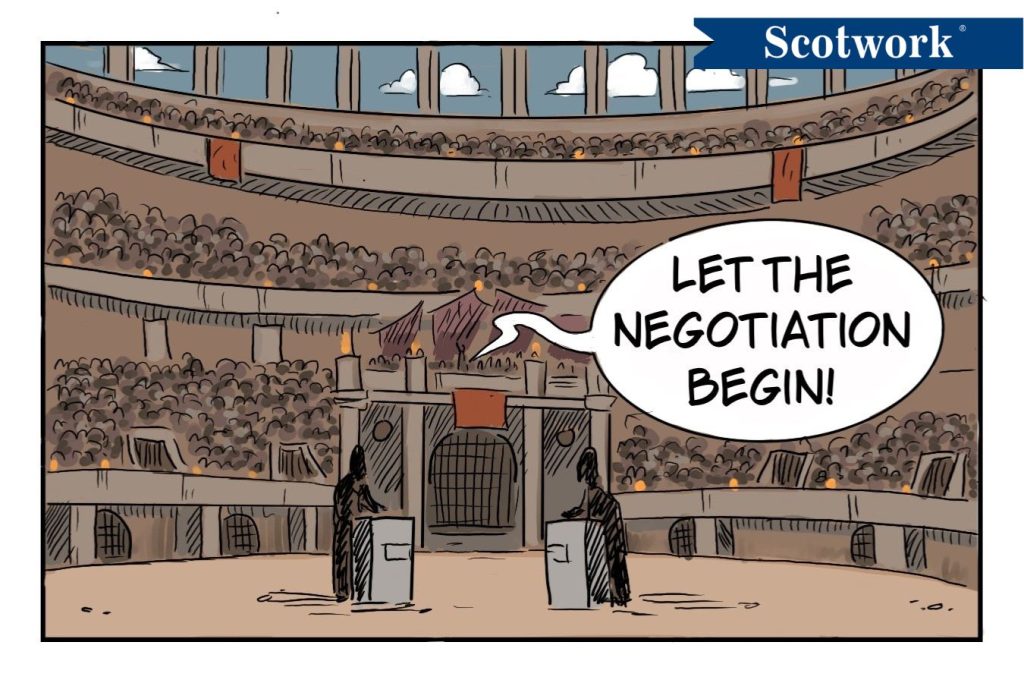
There’s a moment most negotiators recognize. They’re in the middle of a difficult conversation. Things are moving, slowly but surely, in the right direction. Then someone walks in.
Maybe it’s their boss. Maybe it’s the client’s CEO. Maybe it’s a colleague who wasn’t supposed to be there. The dynamic shifts immediately. Suddenly, nobody’s actually negotiating. They’re presenting . . . for the room.
I’ve seen this happen across industries and across the negotiating table. The moment an audience appears, the negotiator’s behavior changes. They start performing in order to look strong in front of whoever just walked in.
Looking strong and reaching a deal aren’t the same thing. Oftentimes, they work against each other.
I think about this as I watch the current situation unfold in the Middle East. I’m not commenting on politics, and I have no interest in the merits of any particular position. What’s happening on that world stage is a master class in what occurs when the audience becomes the primary constituency.
Threats get issued in press conferences. Conditions are set publicly before talks even begin. Positions harden in real time because they were stated in front of millions of people. Every signal of flexibility looks like weakness to the crowd watching at home. Every concession is a headline.
That’s not a negotiation — it’s a performance.
Once you negotiate publicly, you create a trap for yourself. You’ve made commitments in front of witnesses. Now you can’t move without someone tallying the distance between what you said and what you agreed to. Your credibility, at least in front of that audience, depends on holding the line. So, you hold it . . . and the deal gets harder to reach.
The other side faces the same trap. They have their own room. Their own audience. Their own people watching to see if they blink.
Now nobody can move.
The negotiators in these situations aren’t necessarily bad at their jobs. They’re just managing two negotiations at once: the one at the table and the one being watched. And when those two conflict, the one being watched usually wins.
So, how do you keep the room from becoming the problem?
The most effective negotiators I’ve worked with are deliberate about who’s in the room and who isn’t. They resist the pull to perform and stay focused on the question that matters: What do we need to happen here? They understand that progress sometimes requires privacy — the freedom to explore ideas without every word becoming a stated position.
They also know that the minute a negotiation becomes a spectacle, the odds of a good outcome get long. You’re not just resolving a conflict; you’re managing what resolving the conflict looks like to everyone watching. That’s an expensive second job.
I genuinely hope there’s a quick resolution to the current situation in the Middle East. Regardless, it’s a useful reminder that the deal isn’t made only at the table.
Know who your room is. And make sure you’re negotiating for the deal — not for the room.
Negotiation Training and Consulting to Help You Negotiate for the Deal — Not the Room.
In negotiations, it’s tempting to perform in order to look strong. But that comes at the expense of the deal. Rely on Scotwork’s expertise to help your team focus on what matters.