“I Don’t Negotiate at Home.” Really?
 Written by
Brian Buck
| 07/17/2026
Written by
Brian Buck
| 07/17/2026
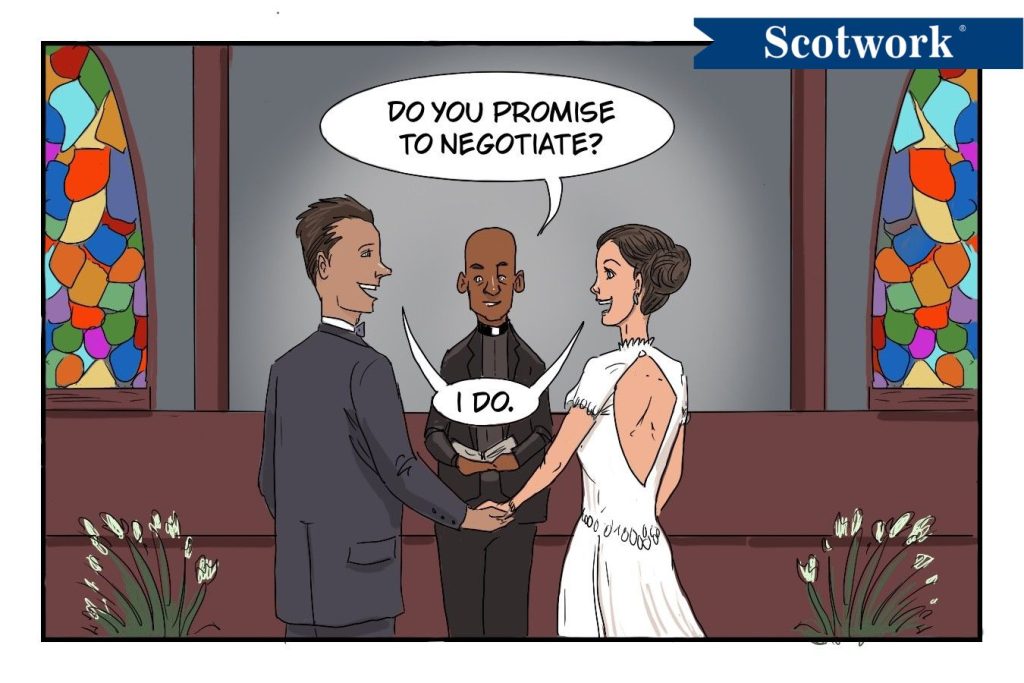
As I go around the country talking to groups about negotiation, I remind people that it’s a life skill they’ll use at work and at home. When I mention this, someone inevitably replies, “But I don’t negotiate at home!”
I used to think that, too, because I used to see negotiation as a fight, a battle of wits. It was a competition, and I was determined to win. So, of course, I thought I didn’t negotiate at home, because that’s not the attitude I’d have at home . . . which is a good thing, because my wife wouldn’t put up with it.
The realization came with our first child. By the time she was born, my wife and I had careers we’d invested years developing. Those careers had been our top priorities. Our daughter quickly changed that, and for the better. With that came an entirely new conversation about the life we wanted.
My wife and I had many similar goals, but we also had a few different ones. I was in the middle of getting my MBA and talking to some friends about a new business we wanted to start. My wife had just gotten a promotion that was opening new doors for her. And we both wanted to be the best parents we could possibly be. But we knew we couldn’t do it all. For the first time, I recognized what an at-home negotiation looked like.
This wasn’t a battle, and it definitely wasn’t a fight. Even though there was no animosity, it wasn’t easy. While we wanted similar things for the family, we wanted different things for ourselves. And that’s exactly why this needed to be a negotiation instead of a contest, or one of us was simply acquiescing to the other.
Once we understood what was important to each of us and where we had flexibility, we started working through our trades and proposals. Yes, trades. We started giving things of lesser importance in return for things of greater importance. If my wife could minimize her travel for the first couple of years of our daughter’s life, then I would delay starting that new business while I finished my MBA. We traded in the convertible sports car and the two-seater pickup for something more practical for our new family. We worked through feeding schedules, diaper changes, TV watching, vacations, savings, schools, and so on.
Even though we were both giving things, we were also getting things. And those trades created a better outcome for all of us. That negotiation shaped the next 23 years of our marriage and became the basis for how we approached raising kids when our second daughter came along two years later.
What surprised me is that it created a framework for more productive conversations down the road. From the mundane (“What’s for dinner?”) to far more challenging ones (healthcare decisions, caring for ailing family members, and so many others).
My negotiations with my family are different from my professional ones. But my goals of preserving or enhancing the relationship and ensuring everyone can support our agreement are exactly the same. The approach and techniques are the same, too. They’re just applied differently based on the situation.
So, the next time someone tells me they don’t negotiate at home, I won’t argue with them. I’ll just ask who decided what was for dinner last night.
Negotiation Training and Consulting to Help You Deal Wherever You Are.
Rely on Scotwork’s expertise to help you get your best outcome regardless of whether it’s with a client, your family, or any other negotiation.
Similar articles
By Brian Buck | 02.10.26
The Deal After the Deal
Last week, roughly 16,000 Boeing engineers and technical workers ratified a new four-year contract, days…

By Brian Buck | 11.09.26
Your Renewal Just Got Flagged
Recently, I worked with a large sales team that showed me something they’d built: an…

By Brian Buck | 28.08.26
Dolly Parton and the Power of Saying No in Negotiation
This past week, we lost Dolly Parton. I have strong memories of riding around in…