Haggling — Moroccan Bazaar Style
 Written by
Brian Buck
| 11/06/2026
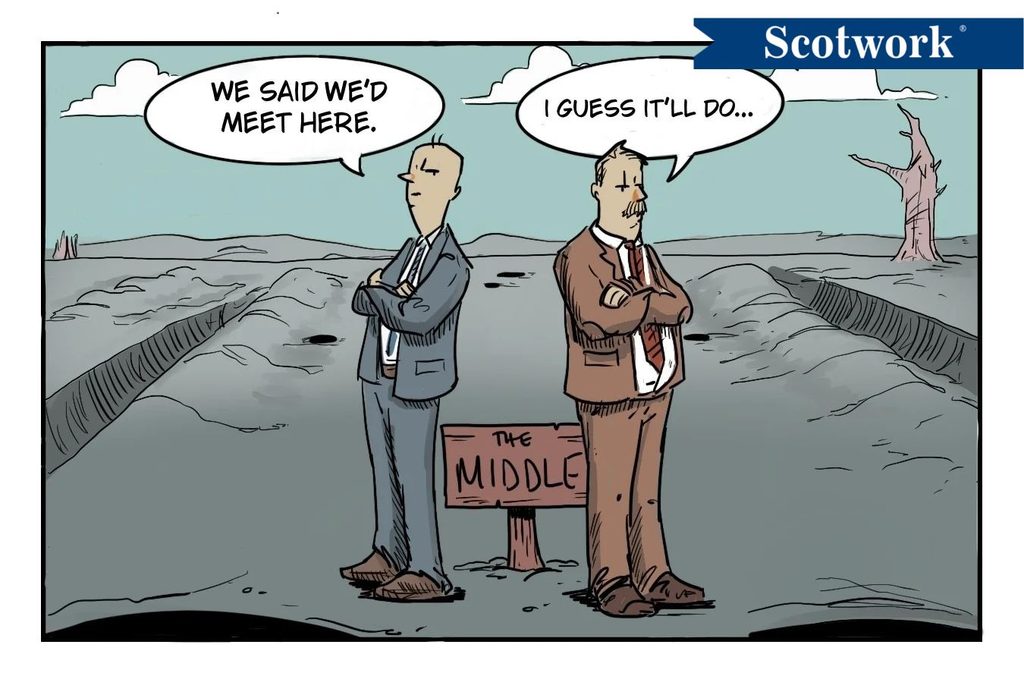
As a kid, I used to go to garage sales with my dad and watch him haggle over all kinds of things: lawn tools, furniture, boxes of who knows what. I thought that’s what negotiating was. Turns out, it’s not — at least not the useful kind.
Haggling is a member of the negotiation family, but it’s a distant cousin. It’s a single-issue battle where the only way for one side to gain is for the other to give. Somebody wins, somebody loses, and often both walk away feeling like they left something behind. That’s why I’ve avoided it. Then I went to Morocco . . .
I was in Casablanca with two colleagues. We went to a bazaar to do some shopping. We’d been told ahead of time that haggling wasn’t just acceptable; it was expected. In fact, not haggling might come across as an insult.
At the first shop, I gave it a try. It didn’t go well. I made an offer; he refused. I made another; he refused that too. He countered; I refused. Round and round we went until I walked out with nothing.
I did better at the second shop. At least it felt that way. My colleagues watched with great interest, offering pointed feedback. Nothing sharpens your technique like an audience of negotiation consultants. Still, no deal.
By the third shop, I’d put it together, walking out with what I came for, at a price both the shopkeeper and I were happy with. Here’s what I learned . . .
1. Know your walkaway before you start.
Determine the most you’re willing to pay before the first word is exchanged. In a haggle, you have one variable, so your limit is the only protection you’ve got. Without it, you’re just reacting, and reacting in a single-issue exchange usually means paying more than you meant to.
2. Do your research.
After browsing a number of vendors’ wares, I had a feel for prices being asked for the things I wanted. That intel set my opening number. In a bazaar, the research takes 20 minutes of walking around. In business, it takes longer, but the principle doesn’t change: You can’t recognize a good price if you don’t know the market.
3. Don’t show how much you want it.
I had to find my poker face. I stopped mentioning that something was for my family, or that I particularly liked it. I feigned mild interest at best. A couple of times, I started for the door to make the point. Wanting something is fine. Advertising how much you want it is expensive.
4. Make an offer. Don’t ask a question.
Several of my early attempts failed because I said things like, “Would you take $X?” That invites one word back: no. When I switched to “I can do $X,” everything changed. A question asks permission and signals there’s more where that came from. A statement is a position.
5. Bundling creates movement.
Haggling over three items got me further than haggling over one, every time. Adding variables is what lets both sides find a trade. That’s also the moment it stops being a haggle and starts being a negotiation.
Which is the real lesson: Negotiating will always create more value for both sides than haggling can, because haggling has only one lever, while negotiating has as many as you’re willing to put on the table. Haggling is transactional, and it has no place in a strategic conversation.
But haggling does have its place: at a garage sale, at a Moroccan bazaar, and anywhere the only thing on the table is price.
Negotiation Training and Consulting to Ensure Your Team Knows How to Use Haggling
Haggling has its place, but only when the only variable on the table is price. Rely on Scotwork’s expertise to help your team understand and use haggling vs. negotiating.
Get in touch with one of our experts today.
FAQ
What’s the difference between haggling and negotiating?
Haggling is a single-issue exchange, usually price, where one side’s gain is the other’s loss. Negotiating involves multiple variables, which lets both sides trade things of different values to create more valuable outcomes.
Should I ever haggle in business?
It works for one-off transactions where price is the only variable. For anything ongoing or strategic, haggling leaves value on the table and can sour the relationship before the work even starts.
How do I turn a haggle into a negotiation?
Add variables: volume, timing, payment terms, scope, length of commitment. The moment there’s more than one thing to move, you can trade instead of just conceding.
What if the other side only wants to talk about price?
Ask what’s driving the number. Price pressure usually comes from something else, like a budget cycle, an internal target, or a comparison to another quote. Once you know, you’ll often find a variable they do care about.
Is it rude to haggle?
It depends entirely on the setting. In some markets, it’s expected and skipping it is discourteous. In others, it signals that you and the other side don’t value the same things. Know the norms before you open.
Similar articles
By Brian Buck | 23.10.26
Zombie Deals
It’s zombie season, which seems like the right time to talk about deals that won’t…
By Brian Buck | 16.10.26
When the Deal Is About You
Recently, I helped a brilliant friend negotiate a job offer. He’s literally a rocket scientist….
By Brian Buck | 09.10.26
Who Goes First?
Last week, I was talking with a friend about dealing with dealers when buying a…