Zombie Deals
 Written by
Brian Buck
| 10/23/2026
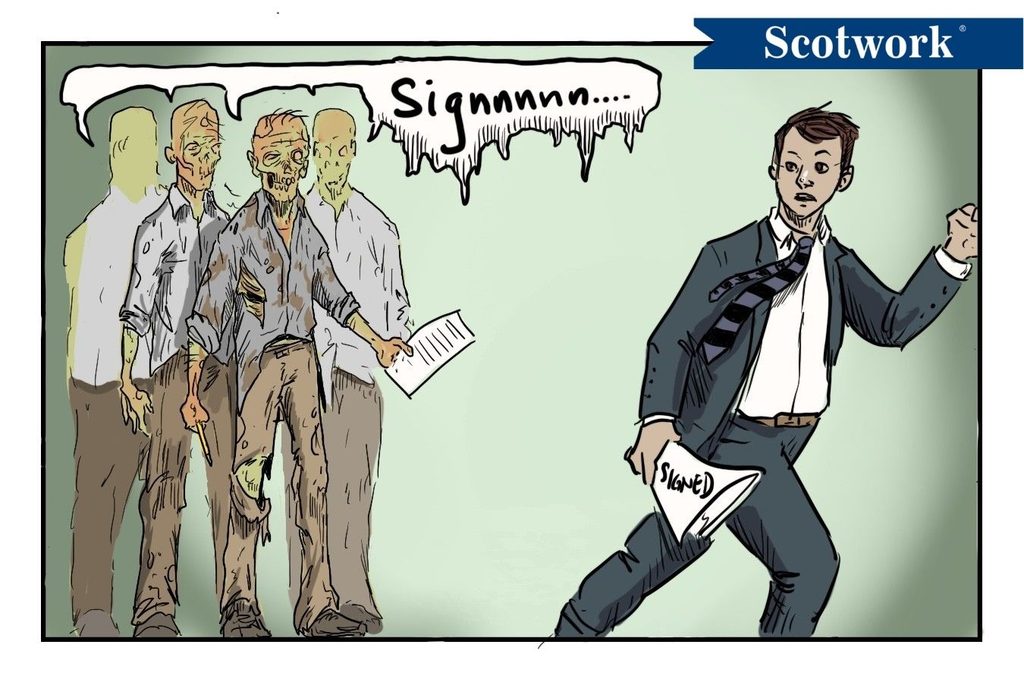
It’s zombie season, which seems like the right time to talk about deals that won’t stay closed — or should I say dead? Every negotiator has one: the issue they closed, only to watch it claw its way back to the table weeks or months later.
Mine came back on a global deal. The work originated with the client’s US office but covered all of their offices worldwide.
One of those offices happened to sit at their global headquarters, so they took over the negotiation. Our collective goal was to build a template that could work for all of their offices and ours. That’s no small task.
Our respective internal negotiations alone were substantial. What we eventually landed on wasn’t what the US office had in mind, but we all agreed to it.
When we applied our template to the first scope of work, they asked for a change to one clause. They treated it as a small administrative adjustment, but that clause had been one of the biggest issues in the original negotiation.
And just like that, we were negotiating again. Reopening negotiations over a settled issue wasn’t something either side had planned. We said that renegotiating a closed issue was bad faith. They said we should be more flexible. What finally broke the cycle was advice I’ve given to other people more times than I can count: Is it better to be right or to be understood?
I started asking questions: Why was this change important to them? What was driving it now, when we thought it was settled earlier? Under what circumstances could we live with it?
Once I did that, I stopped seeing a zombie and started seeing the real problem: They were struggling to articulate an issue, and the clause change was the only solution they could think of. Once I understood the problem, we repackaged their ask so it worked for us and gave them what they were trying to achieve. That’s when the zombie died.
Here are 5 ways to handle reopening negotiations without unleashing your own zombie apocalypse . . .
1. Find out what changed.
Before you argue about whether they should be reopening an issue, find out why it came back. The answer usually tells you whether you’re dealing with a genuine problem or a second bite at the apple.
2. Stop arguing about the principle.
Being right about process doesn’t get you anywhere. They weren’t going to concede the principle, and we weren’t going to concede the clause. Arguing about whether a conversation should be happening is not the same as having it.
3. Separate the ask from the need.
What someone asks for and what they actually need are rarely the same thing. Once you understand the true nature of the problem, you’re free to solve it creatively.
4. Repackage rather than reopen.
Reopening a deal invites everything else back onto the table. Solving their problem inside the existing structure, as an addendum, an exception, or a defined circumstance, kills the zombie without resurrecting the negotiation.
5. Bury it properly the first time.
When you settle a hard point, write down not just the outcome, but the reasoning and the conditions behind it. The next person to pick up the file, on either side, then inherits the logic instead of just the language.
Not every returning deal is a zombie
Some deals that come back deserve to come back. A prospect who went quiet for six months and resurfaced with a new budget and a new mandate isn’t a zombie — they have a real opportunity. If it’s the same deal with the same obstacle, you’re feeding something that should’ve been allowed to rest.
Training and Consulting to Handle Reopening Negotiations
Negotiations that won’t stay closed (or rise from the dead) churn your team’s time and strain your professional relationships. Rely on Scotwork’s expertise to help you close your deals and keep it closed.
Get in touch with one of our experts today.
FAQs
What do I do when the other side reopens a closed issue?
Find out what changed before you react. Then decide whether you’re being asked to solve a real problem or to give back ground you already won.
Isn’t reopening a settled issue negotiating in bad faith?
Sometimes, but less often than it feels. More often, it’s a new person, a new constraint, or someone who never understood why the issue closed the way it did. Assume the former and you’ll argue. Check first and you’ll usually find the latter.
How do I keep a closed issue closed?
Document the reasoning, not just the result. An agreement that records why a term exists is much harder to pick apart than one that only records what it says.
How do I know whether a dormant deal is worth reviving?
Ask what’s changed since it died: New budget, new stakeholder, new problem, or new urgency all make it worth a call. A new quarter does not.
Can I revive a dead deal myself?
Yes. Most deals die over a specific obstacle. If you can come back with a different package that addresses it, you’re not pestering them. You’re giving them a reason to reopen the conversation.
Similar articles
By Brian Buck | 16.10.26
When the Deal Is About You
Recently, I helped a brilliant friend negotiate a job offer. He’s literally a rocket scientist….
By Brian Buck | 09.10.26
Who Goes First?
Last week, I was talking with a friend about dealing with dealers when buying a…
By Brian Buck | 02.10.26
The Deal After the Deal
Last week, roughly 16,000 Boeing engineers and technical workers ratified a new four-year contract, days…