Driving a Good Deal to the Finish Line
 Written by
Trevor Murphy
| 07/31/2026
Written by
Trevor Murphy
| 07/31/2026
“I have a great idea.”
In a marketing agency, this statement comes up in many meetings. It may not always be true, but it’s possible that it starts a deal that gives rise to a great campaign; in other words, it’s a call to adventure.
In this case, an account strategy leader made the claim in a brainstorming session between the agency and a key client. It was a good pitch with a big idea to raise awareness, using eye-catching mailers timed to coincide with online ads just as they landed in people’s homes.
The room was enthused. It seemed like we might be on the way to a quick agreement to get started . . . until one stakeholder rightly asked about execution issues that had proven thorny in the past.
Did both sides have the same concept of the Big Idea? If not, the campaign’s artwork could get bogged down. Who was ultimately responsible for managing the data for the mailers? Processing deadlines could be uncomfortable and quickly become red-hot. Managing the online component would be equally challenging.
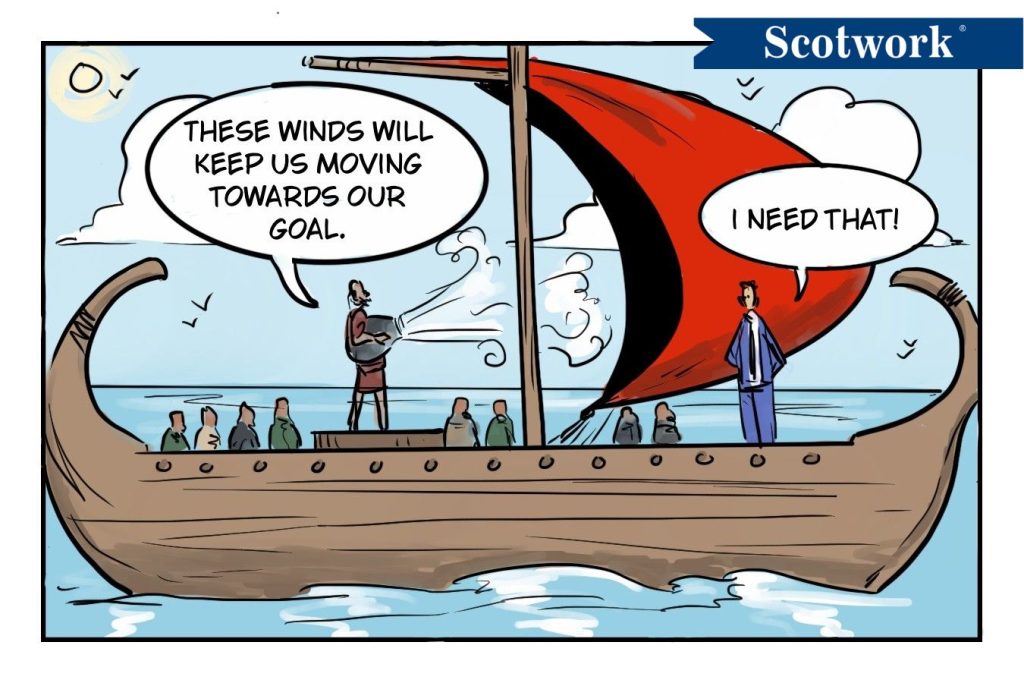
You could feel the wind in the meeting’s sails dwindle. The strategist was ready, though, to keep the team moving toward a green light. I was careful to observe how this strategist kept propelling the deal; it reminded me of reading the Odyssey in a class, the way the main character opens a bag of winds to keep the boat moving to shore.
The deal process extended beyond the brainstorming session, involving conference calls and emails between meetings. Here’s how our leader kept the deal in motion.
Summarize meetings regularly. We worked to minimize how much “a great idea” varied between stakeholders by summarizing what was discussed and creating or reinforcing alignment throughout meetings. If development lasted over multiple meetings, those summaries were invaluable as records of what we had already covered.
Agree what’s been agreed to. We didn’t get stuck on the question of what was already determined. Additionally, if an item had been discussed and agreed to and still needed to be changed, we did it thoughtfully. Goals didn’t simply morph from one objective to another and leave some stakeholders behind.
Specify who’s doing what. This was the most impactful change and always brought clarity. Either the task had been assigned, or if no one would own it, the teams would discuss why. Was the scale of the task too great for the assigned resources, or did it just need to be defined more clearly?
The agency closed the deal with the client’s approval. The start of a solid campaign project plan was drawn from the agreements in the meeting summaries.
It was a strong campaign, and the combination of the tactics was attention-grabbing. If you received it, you might still remember it.
But nothing would have happened without the techniques to keep driving the deal forward, and I use them today whenever possible to set up the next adventure.
Negotiation Training and Consulting to Get Your Deal Over the Finish Line.
Rely on Scotwork’s expertise to help you make the “great idea” in your deal a reality.
Similar articles

By Brian Buck | 11.09.26
Your Renewal Just Got Flagged
Recently, I worked with a large sales team that showed me something they’d built: an…

By Brian Buck | 28.08.26
Dolly Parton and the Power of Saying No in Negotiation
This past week, we lost Dolly Parton. I have strong memories of riding around in…
By Brian Buck | 17.07.26
“I Don’t Negotiate at Home.” Really?
As I go around the country talking to groups about negotiation, I remind people that…